

Parking Lot Striping Maintenance Schedule — Repaint Intervals and Inspection Cycle
Faded striping is not just an appearance issue — it is an ADA compliance issue and a premises liability issue. Here is the maintenance schedule that keeps your lot compliant.
Paint Marking Repaint Cycle (12 to 24 Months)
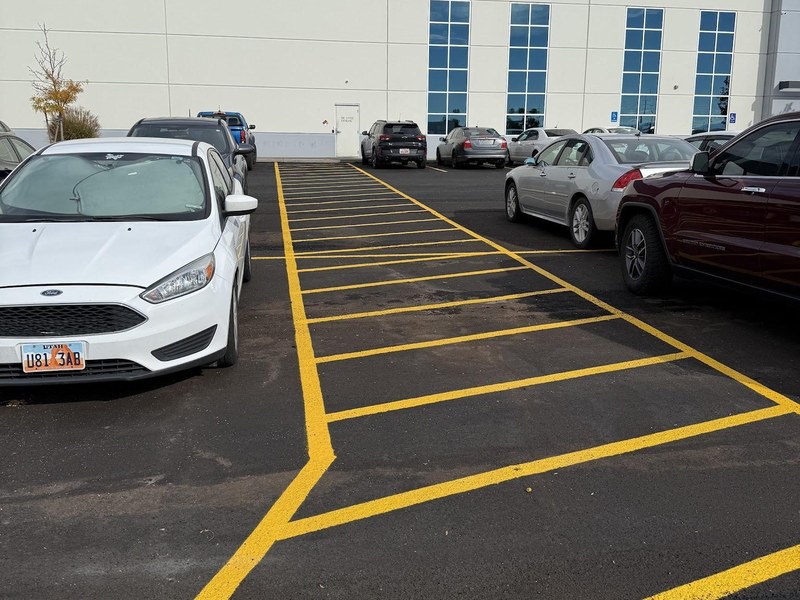
Traffic paint in a commercial parking lot fades with UV exposure, tire abrasion, and snow plowing. In Utah's high-altitude UV environment (4,500 to 4,800 feet elevation), paint fades 30 to 40 percent faster than in coastal markets. For customer-facing commercial lots (retail, restaurant, multifamily), a 12-month repaint cycle for primary markings (fire lane, accessible stalls, stop bars) and 18 to 24 months for stall field lines is appropriate. High-traffic primary drive aisles, intersection markings, and accessible stall symbols may require annual repainting. Lots on a biennial seal coat cycle should repaint all markings as part of the seal coat project—the seal coat covers all existing markings, and re-striping is mandatory after each seal coat application.
Thermoplastic Repaint Cycle (5 to 7 Years)
Thermoplastic requires repainting at 5 to 7 years in commercial parking applications. The first indicator of end-of-service is retroreflectivity loss—when nighttime visibility of markings is noticeably reduced. The second indicator is aggregate depletion in the surface of the marking—thermoplastic with worn-off glass beads appears as a smooth white or yellow band with reduced traction. The third indicator is edge curl—thermoplastic edges curl up on heavily patched or aged pavement surfaces. At any of these indicators, schedule repaint. Thermoplastic cannot be repainted over existing thermoplastic; the old marking must be ground off or the new application built over it (which increases thickness and may cause edge cracking).
Annual ADA Compliance Inspection
Regardless of striping material, accessible stall markings should be inspected annually for: ISA symbol visibility (minimum 50 percent of original contrast still visible); access aisle "NO PARKING" text legibility; stall width dimension verification (stalls do not narrow due to adjacent parking damage or patching); and sign post condition (post not bent, sign at correct height, ISA symbol not faded). ADA compliance inspections following any lot modification—patching adjacent to accessible stalls, changes in lot layout, new tenants affecting accessible route—are mandatory before re-opening the modified area. We provide written ADA stall inspection documentation after every striping project.
MUTCD Retroreflectivity Maintenance
MUTCD Section 3A.03 (Retroreflectivity of Pavement Markings) establishes minimum maintained retroreflectivity levels that agencies are required to achieve. For commercial lots, the standard is a best-practice target: white lines at minimum 100 mcd/lux/m2; yellow at 75 mcd/lux/m2. Retroreflectivity can be measured with a portable retroreflectometer (we carry one and can test your markings during a site walk). Below minimum: repaint immediately. 100 to 200 mcd/lux/m2: repaint within the next scheduled cycle. Above 200 mcd/lux/m2: no immediate action required. Maintaining MUTCD-compliant retroreflectivity on fire lanes and accessible stall borders reduces premises liability exposure from nighttime accident claims.
Recent Striping Projects


Common Questions
- How do I know when to repaint versus when to just touch up?
- Touch-up (applying new paint over faded existing lines) is acceptable when the existing marking is still adhered, the line is still visible in its full width, and the fading is uniform. Touch-up is not appropriate when the existing marking has peeled, cracked, or has uneven coverage—touch-up over failed paint produces an inconsistent appearance. When more than 30 percent of a marking length is below minimum visibility, full repaint is more cost-effective than patchy touch-up.
- Does seal coat always require re-striping?
- Yes. Seal coat covers all existing pavement markings completely. Re-striping after seal coat is mandatory—all stall lines, ADA symbols, fire lanes, stop bars, and directional arrows must be replaced. We include re-striping in every seal coat project scope and ensure the seal coat has cured for a minimum of 24 hours before the stripe crew arrives.
- How long does a full re-stripe last before it needs to be done again?
- With traffic paint: 1 to 3 years for field stall lines; 12 to 18 months for fire lanes and accessible stall symbols in high-UV conditions. With thermoplastic: 5 to 7 years for all markings. Schedule thermoplastic for safety-critical markings and either thermoplastic or paint (depending on seal coat cycle) for stall field lines.
Ready to Get Started?
Get a free, itemized estimate for your commercial striping project. We typically schedule site visits within 48 hours and deliver written quotes the next business day.
Get In Touch
Ready for a quote or have a question? We’re Utah-based, Utah-run, and we’ll come out to your property for a free on-site estimate.
Get A Free Quote