

Striping Common Issues — Fading, Peeling, ADA Deficiencies, and Thermoplastic Problems
Striping failure has identifiable causes and predictable solutions. Here is the diagnostic guide for facility managers.
Issue: Paint Peeling from Pavement Surface
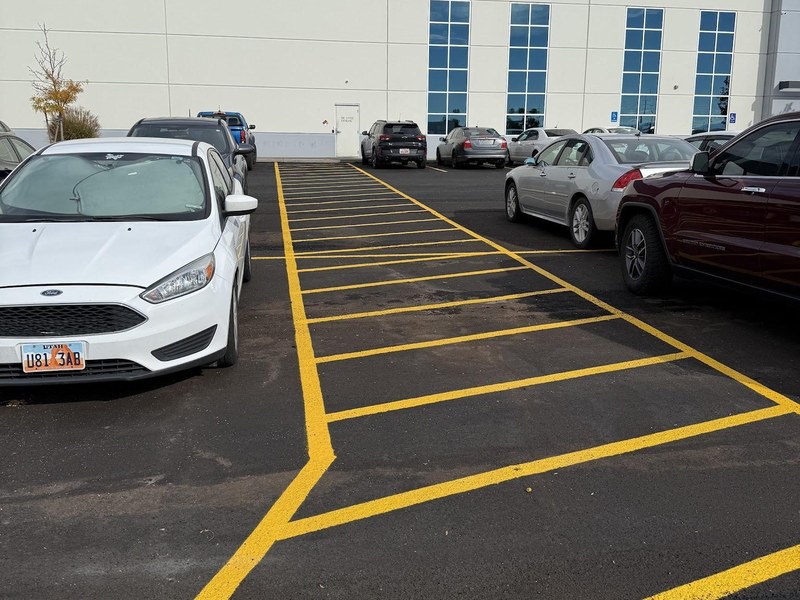
Symptom: Traffic paint peeling off the pavement in flakes or sheets, particularly in wheel track areas or along seal coat edges. Diagnosis: Bond failure between paint and substrate. Most common causes: (1) paint applied over moist or dew-covered pavement—moisture prevents adhesion at the paint-pavement interface; (2) paint applied over a freshly sealed surface before seal coat achieved full cure (24 hours minimum—paint applied in less than 24 hours peels with the under-cured sealer); (3) paint applied over oil-contaminated pavement where oil repels the water-based paint; (4) extreme cold at time of application (below 50°F) prevents proper film formation. Solution: remove peeled paint by wire brushing, confirm surface is clean and dry, wait for appropriate weather conditions, and re-apply. If the underlying pavement or seal coat is the cause (oil contamination, incomplete cure), address the substrate issue before re-striping.
Issue: Faded ADA Blue (ISA Symbol Background)
Symptom: The blue background of the international symbol of accessibility (ISA) has faded to a gray-blue or white appearance, reducing the contrast ratio below ADA recognition standards. Diagnosis: Federal ADA blue (Federal Standard 595 Color 15050) is inherently UV-sensitive. In Utah's high-altitude UV environment, painted blue backgrounds lose 50 percent of their chroma within 12 to 18 months. Many contractors use lower-quality pigment that fades even faster. Solution: for commercial lots, specify thermoplastic for ADA symbol backgrounds rather than traffic paint. Thermoplastic blue pigment is UV-stable and maintains recognizable chroma for 4 to 6 years. For lots where painted blue is already faded, repaint in the current maintenance cycle—faded ISA symbols are an ADA enforcement risk. Federal Yellow tinted blue is not an acceptable substitute for Federal ADA blue.
Issue: Thermoplastic Chipping or Delaminating
Symptom: Thermoplastic marking has cracked and is lifting from the pavement surface in chips or slabs. May appear along edges first, then progress to full-width delamination. Diagnosis: Two causes. (1) Cold-applied vs. hot-applied thermoplastic error—true alkyd thermoplastic must be applied at 400 to 430°F. A product marketed as "cold-applied thermoplastic" is actually a thick paint product and lacks the bonding mechanism of true hot-applied material. Cold-applied products chip and delaminate within 1 to 2 seasons. (2) Application over a contaminated surface (oil, seal coat residue, or wet pavement)—thermoplastic does not bond to these surfaces and delaminates under tire flex. Solution: confirm the product specification (hot-applied alkyd thermoplastic per AASHTO M249). Remove delaminated material by grinding. Clean the pavement surface thoroughly. Re-apply hot-applied thermoplastic during appropriate weather conditions.
Issue: Fire Lane Red Fading to Pink or White
Symptom: Fire lane curb paint or fire lane surface stencil has faded from red to pink or near-white, reducing visibility and potentially creating fire code violations if markings are no longer clearly identifiable as fire lanes. Diagnosis: Traffic paint red contains iron oxide pigment that is susceptible to UV bleaching in Utah's climate. Red pigment fades faster than white or yellow pigment under high UV. At altitude, red paint can fade to pink within one Utah summer. Solution: specify thermoplastic for fire lane markings—thermoplastic red maintains color significantly longer than paint red in UV-intensive climates. For existing faded fire lane paint, repaint annually (if using traffic paint) or upgrade to thermoplastic at the next re-striping cycle. Fire marshals occasionally cite properties for fire lane marking that is no longer clearly red—document your repaint schedule as due diligence.
Recent Striping Projects


Common Questions
- How quickly does traffic paint fade in Utah compared to other states?
- Utah's combination of high altitude (increased UV intensity), low humidity (reduced UV diffusion), and extreme temperature cycling accelerates traffic paint fading significantly compared to coastal markets. A typical white traffic paint application that lasts 24 to 36 months in the Pacific Northwest will last 12 to 18 months in the Salt Lake Valley under similar traffic conditions. Budget for more frequent repaint cycles than you would in lower-UV environments, or specify thermoplastic for high-visibility safety markings.
- Can snow plowing damage parking lot striping?
- Yes. Steel-blade snow plows can scour paint and even thermoplastic from the pavement surface in one winter season if the blade contacts the pavement directly. Plow operators should use rubber cutting edges or skid shoes to maintain 1/8-inch clearance from the pavement surface. For lots with aggressive winter maintenance, thermoplastic is more durable than paint but will still show wear in areas with repeated blade contact.
- Why do stall lines look wavy or uneven after seal coat?
- Wavy stall lines after seal coat are typically the result of uneven seal coat film build—the sealer is thicker in some areas, creating a slightly textured surface that makes the overlying stripe appear wavy under raking light. This is a cosmetic issue caused by seal coat application variability, not a striping problem. It is most visible when fresh but becomes less apparent as the seal coat wears to a more uniform surface over several months.
Ready to Get Started?
Get a free, itemized estimate for your commercial striping project. We typically schedule site visits within 48 hours and deliver written quotes the next business day.
Get In Touch
Ready for a quote or have a question? We’re Utah-based, Utah-run, and we’ll come out to your property for a free on-site estimate.
Get A Free Quote