
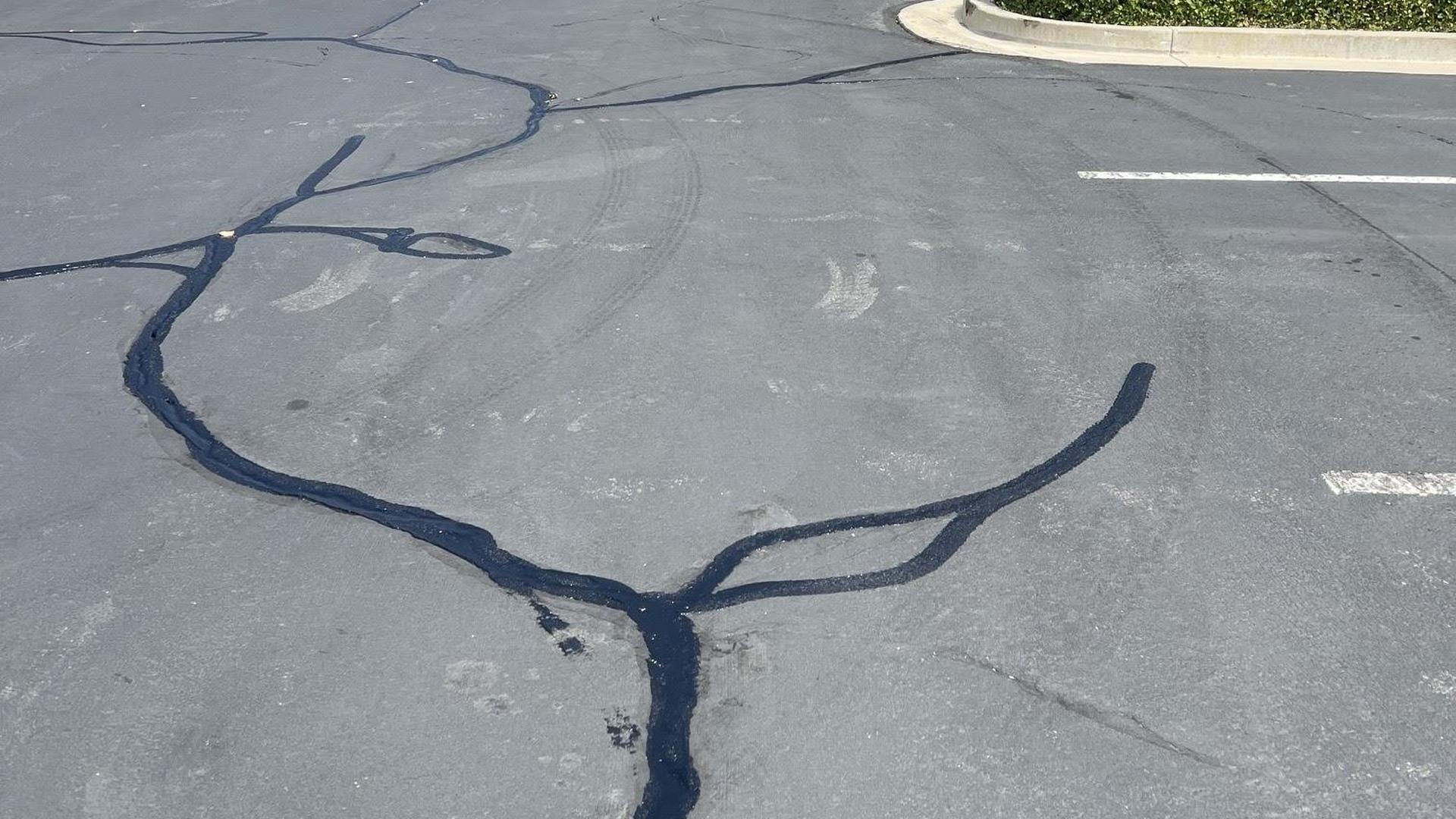
Crack Seal Process — Step-by-Step from Crack Survey to Sand Broadcast
A crack seal application is only as good as the prep work. Here is the full process we follow on every commercial property.
Step 1 — Crack Survey and Mapping
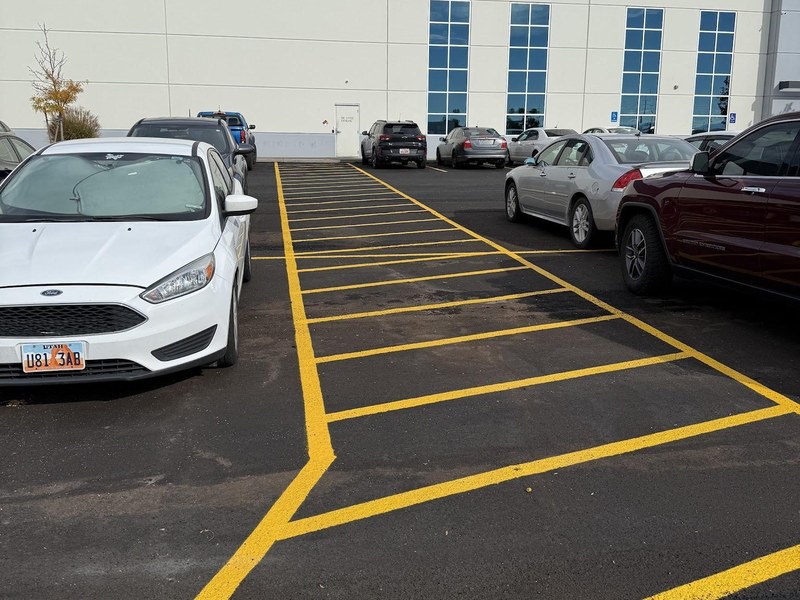
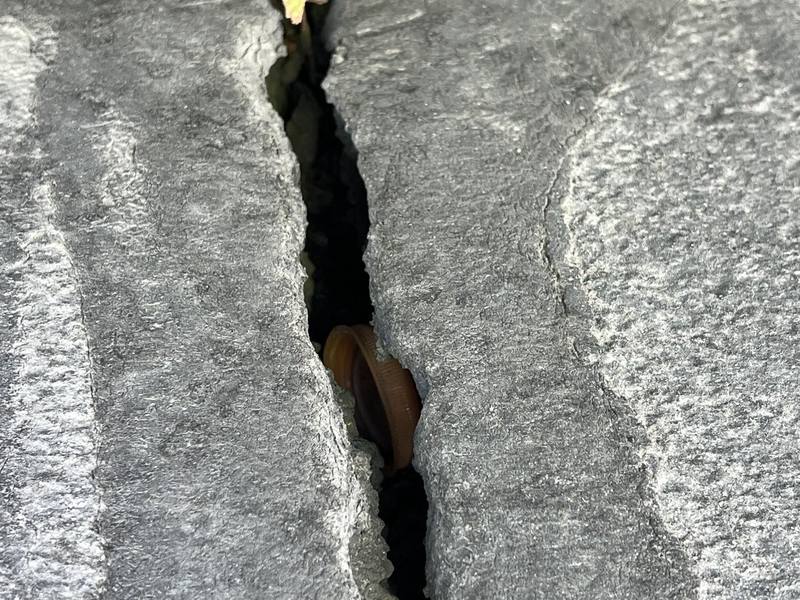
Before mobilizing equipment, we walk the lot on foot and map crack locations, widths, and types. We distinguish sealable cracks (1/4 inch to 1.5 inches wide, working cracks with functional pavement on both sides) from non-sealable conditions (alligator-cracked areas requiring patching, edge cracks with base undermining). We measure total linear footage of routable versus clean-and-fill cracks and confirm this matches the quoted scope. Any additional or previously unmapped cracks discovered on the day are measured and quoted as a field addition before work begins on those areas. The survey map is provided to you at project close for your property records.
Step 2 — Routing (On Cracks Over 1/2 Inch)
Routing creates a uniform reservoir channel along the crack path—3/4 inch wide and 3/4 inch deep—that holds significantly more sealant and provides a clean bonding surface. The router bit is a carbide-tipped circular blade riding on a depth guide. Router speed is controlled to prevent overheating the crack walls, which would glaze the asphalt surface and reduce adhesion. Routing debris (fine aggregate and asphalt dust) is collected continuously by the router vacuum attachment. We do not leave routing debris on the pavement surface—it becomes a sealant contamination source if not removed. Routing is noisy and generates asphalt dust; we schedule routing work to avoid peak business hours when possible.
Step 3 — Crack Cleaning
After routing, all cracks receive compressed air cleaning at a minimum of 100 PSI to remove dust, debris, and any moisture from the crack channel. On lots with heavy organic debris (leaf litter, dirt accumulation in cracks), we additionally wire-brush the crack walls before air-blowing. In humid conditions or when morning dew is present, we use a hot-air lance (propane burner on a wand) to dry the crack channel before sealant application. A moist crack wall is the most common cause of sealant debonding—the water forms a vapor barrier between the sealant and the asphalt. We visually inspect the interior of each routed channel before applying sealant; any debris or visible moisture causes us to re-clean rather than proceed.
Step 4 — Hot-Pour Sealant Application and Sand Broadcast
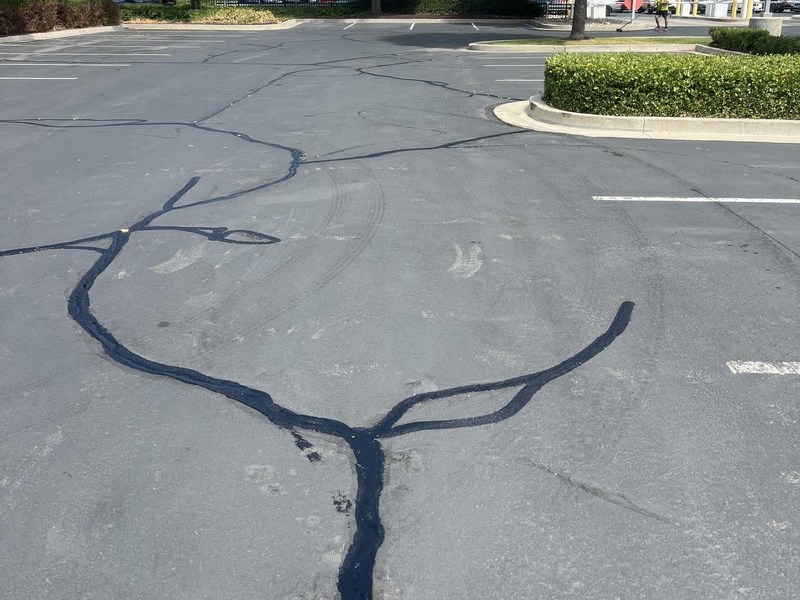
The melter-applicator heats ASTM D6690 Type IV sealant to 380 to 400°F. We confirm application temperature with a digital thermometer before beginning production—sealant applied below 375°F has insufficient penetration viscosity; sealant above 410°F begins to degrade. Application rate: the sealant fills the crack channel from the bottom, with a slight overband (1 to 2 inches beyond the crack edge) on both sides to prevent edge-of-seal water intrusion. The overband is squeegeed flush to prevent tire pickup. Within 60 to 90 seconds of application, a silica sand broadcast is applied over the bead to prevent tire adhesion during the 20 to 30-minute tack-free window. Sand is applied by hand-broadcast or mechanical spreader, and excess sand is swept up after tack-free is confirmed.
Recent Crack Seal Projects
Common Questions
- How long does a crack seal application take?
- Production rate is typically 500 to 800 linear feet per hour for routed crack sealing, or 800 to 1,200 linear feet per hour for clean-and-fill. A lot with 2,000 linear feet of routable cracks requires 3 to 4 hours of production work plus 1 to 2 hours of setup and cleanup. Most commercial crack seal projects complete in a single day.
- Do we need to mark cracks before your crew arrives?
- No. Our crew performs the crack survey on the day of work. If you have already identified specific areas of concern (a crack that has grown quickly, a recent utility excavation area), point these out to the crew lead and they will prioritize them in the survey.
- What happens if rain is forecast on the scheduled day?
- We monitor the forecast 48 hours ahead and will contact you to reschedule if rain is probable within 4 hours of scheduled crack sealing. Sealant applied to a wet crack will not bond. We do not apply crack sealant if the pavement is wet from recent precipitation.
Ready to Get Started?
Get a free, itemized estimate for your commercial crack seal project. We typically schedule site visits within 48 hours and deliver written quotes the next business day.
Get In Touch
Ready for a quote or have a question? We’re Utah-based, Utah-run, and we’ll come out to your property for a free on-site estimate.
Get A Free Quote