
Crack Seal Common Issues — Failures, Causes, and Fixes
Crack sealing failures have identifiable causes. Most are preventable with proper application. Here is the diagnostic guide.
Issue: Sealant Tracking onto Adjacent Surfaces
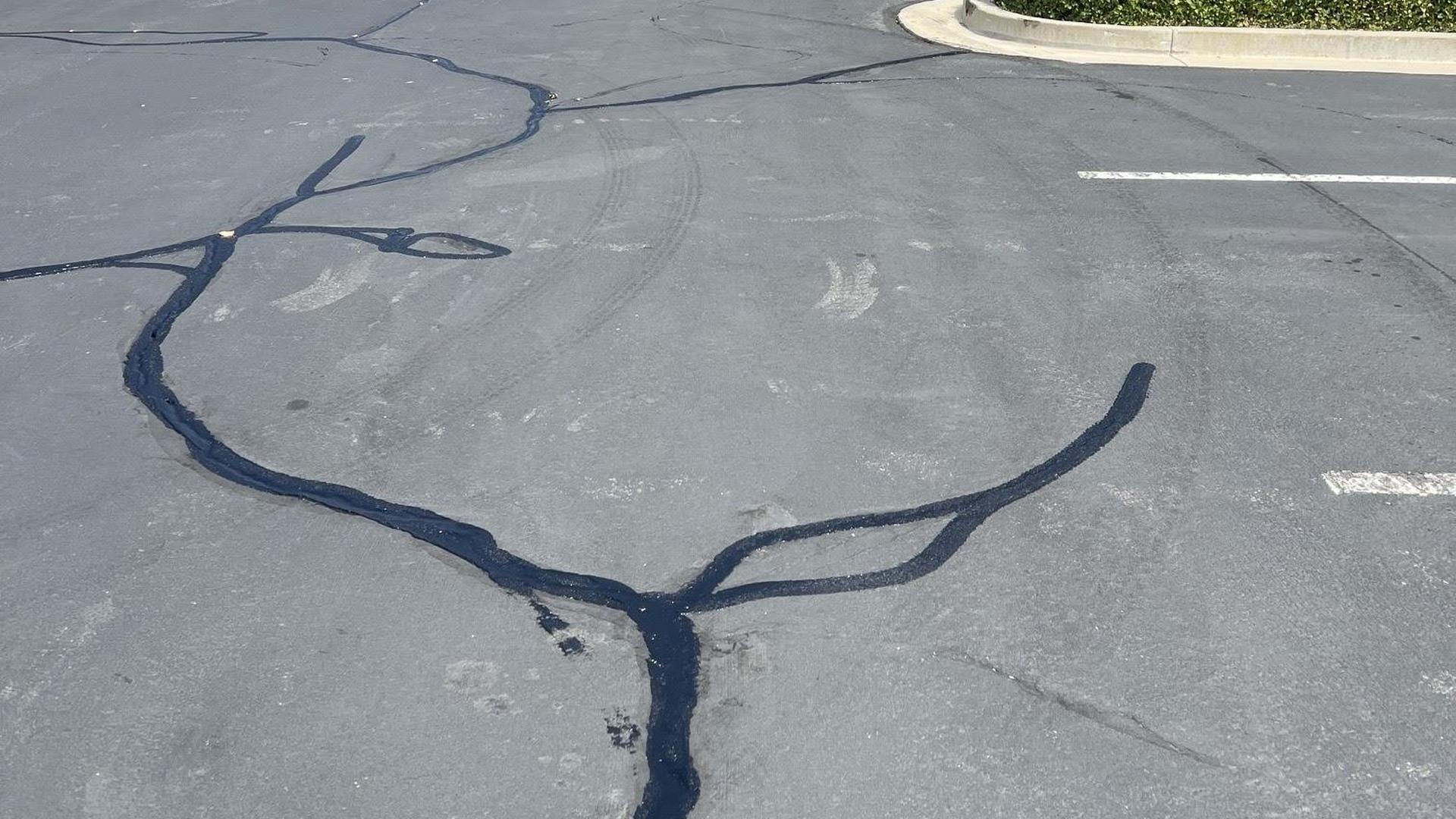
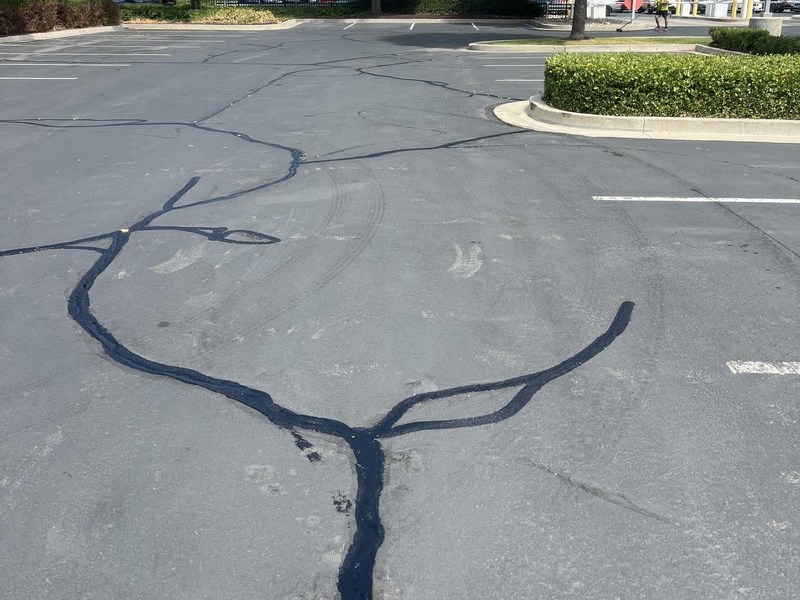
Symptom: Dark sealant tracked by vehicle tires from the application area onto clean pavement, building entry areas, or adjacent sidewalks. Diagnosis: Sealant was not tack-free before traffic was allowed on the treated area, or sand broadcast was insufficient to prevent tire adhesion. Application temperature at or above 400°F produces a sealant with longer tack-free time. High ambient temperature slows cooling and extends the tracking window. Solution: Apply sand broadcast immediately after application—within 60 seconds. Confirm tack-free state (press a dry finger firmly onto the sealant surface; it should not pull away sticky) before removing traffic cones. Standard tack-free time at 70°F ambient: 20 to 30 minutes. At 90°F ambient: 35 to 50 minutes. Protect building entries with plastic sheeting during application in high-risk areas. Tracked sealant on concrete or pavers can be removed with a heat gun and scraper while soft; once fully cured, abrasive methods are required.
Issue: Sealant Pull-Out from Crack Channel
Symptom: Sealant bead has de-bonded from the crack walls on one or both sides, often pulling out in chunks or peeling back from the edges. Diagnosis: Bond failure between sealant and asphalt substrate. Primary causes: moisture in the crack channel at time of application (most common), application temperature below 375°F (insufficient penetration viscosity), routing debris left in the channel, or fuel/chemical contamination on the crack wall surfaces. Solution for fresh pull-out (within 30 days): remove failed sealant by routing, clean channel thoroughly including hot-air lance drying, and re-apply at correct temperature. Contact us within the warranty period—pull-out within 60 days of application is covered by our workmanship warranty. For pull-out at reflective crack locations, understand that the underlying movement is the driving force—hot-pour sealant is the best available treatment but will require re-application every 2 to 3 years at those locations.
Issue: Premature Crack Reopening Through Sealant
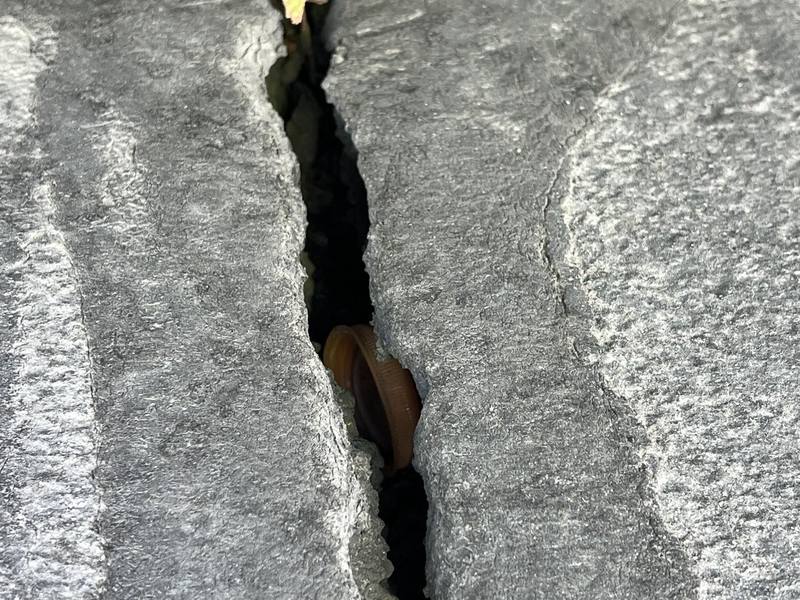
Symptom: Cracks visible through the sealant bead within one season of application, often following a visible tear through the sealant center. Diagnosis: The crack is still active (moving more than the sealant's elastic capacity can accommodate), or the sealant was applied too thin. ASTM D6690 Type IV sealant has an elongation capacity of 250 to 400 percent—it can stretch significantly before tearing. Crack reopening through sealant typically indicates movement greater than the sealant can accommodate. This occurs at: structural cracks over failing base (base movement drives the crack); reflective cracks over concrete joints (predictable seasonal movement); or cracks in a freeze-thaw cycle with unusual severity. Solution: confirm the substrate failure mode. If structural, patch the area. If reflective, accept re-sealing as an annual maintenance item. If movement appears greater than expected for the thermal cycle, assess whether a drainage failure is saturating the sub-base and increasing movement.
Issue: Birdbath Formation at Sealed Crack
Symptom: Water pools on the pavement surface at or adjacent to a sealed crack. The sealant bead is proud of the surrounding surface, creating a dam, or the overband squeegee work left a ridge that directs drainage toward the crack rather than away. Diagnosis: Sealant was applied over-full and not squeegeed flush, or squeegee work was done against the drainage direction. A sealant bead raised 1/8 inch above grade is sufficient to create a 1 to 2 square foot birdbath in flat lot areas. Solution: re-heat the raised bead with a heat gun until workable, flatten with a steel trowel, and confirm flush finish. Do not overfill on re-application. For severe birdbaths where the surrounding pavement has a drainage grade that directs water toward the crack, a local pavement overlay may be necessary to correct the grade.
Recent Crack Seal Projects
Common Questions
- What is your warranty on crack sealing work?
- We warrant crack sealing workmanship for 60 days from application against pull-out or de-bonding caused by our application process. We do not warrant against reflective crack reopening (an inherent movement issue), structural failures causing crack re-opening before base repair, or damage caused by fuel spills on the sealant surface after application.
- How do I remove failed crack sealant to prepare for re-application?
- Failed sealant (de-bonded, raised, or crumbled) must be removed before re-sealing. The router is the correct tool—re-route the channel to 3/4 inch width and 3/4 inch depth, removing the failed sealant and preparing fresh asphalt bonding surfaces. Do not apply new sealant over failed old sealant; the bond will fail at the same interface.
- Why does sealant look different colors (tan, gray, brown) on different parts of the lot?
- Fresh hot-pour sealant is dark brown to black when applied. Color variation after curing reflects the sand broadcast color (silica sand is typically tan to gray), UV weathering (sealant lightens slightly over 6 to 12 months), and dust or dirt accumulation. Color variation is cosmetic—it does not indicate a quality difference in the underlying sealant application.
Ready to Get Started?
Get a free, itemized estimate for your commercial crack seal project. We typically schedule site visits within 48 hours and deliver written quotes the next business day.
Get In Touch
Ready for a quote or have a question? We’re Utah-based, Utah-run, and we’ll come out to your property for a free on-site estimate.
Get A Free Quote