
Asphalt Repair Compliance — ADA Cross-Slopes, OSHA, and Utah Municipal Requirements
Asphalt repair is not just a maintenance function—it is a compliance function. ADA cross-slope failures, OSHA surface hazards, and municipal code violations are built into poorly executed repairs.
ADA Cross-Slope Requirements for Accessible Routes
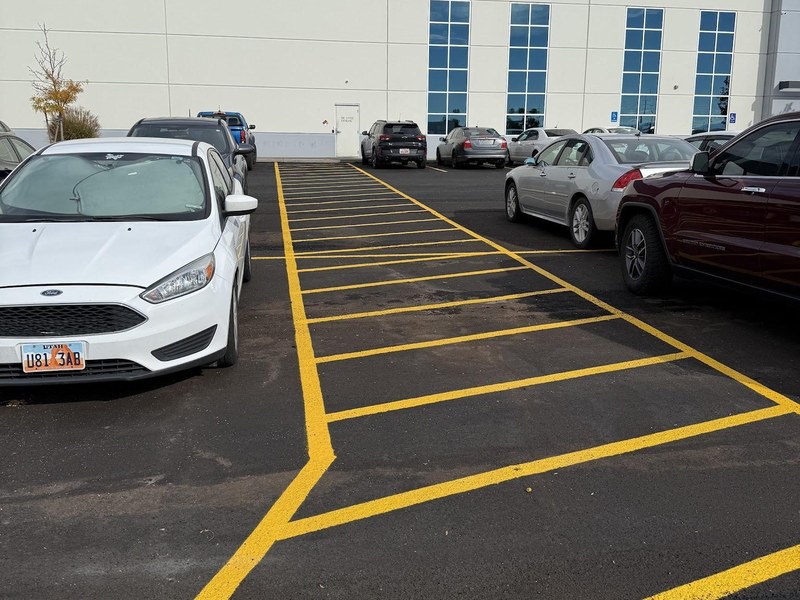
ADA 2010 Standards Section 402 requires that accessible routes maintain a maximum running slope of 1:20 (5 percent) and a maximum cross slope of 1:50 (2 percent). This applies to the paved surface along the entire accessible route from parking to the building entrance. When an asphalt repair is executed in or adjacent to an accessible route, the repaired surface must meet these slope tolerances. A patch that crowns higher than the surrounding pavement, or that bridges a drainage gutter with a cross-slope exceeding 2 percent, creates an ADA-deficient path of travel. We check cross-slope on all repairs within accessible parking areas and accessible routes using a digital level before accepting the work. Patches that fail the slope check are re-worked before we leave the site.
OSHA Surface Safety in Commercial Settings
OSHA 29 CFR 1910.22(a)(1) requires that all places of employment, passageways, storerooms, and service rooms be kept clean and orderly, and in sanitary condition. Section 1910.22(a)(2) requires that the floor of every workroom be maintained in a clean and dry condition. For parking lots and exterior paved surfaces, this translates to: no potholes or surface failures that present tripping hazards; no drainage failures that create standing water on pedestrian paths; and no depressions that accumulate ice in winter. OSHA citations for exterior surface conditions are uncommon but occur following employee injury incidents—slip and fall on ice accumulated in a drainage depression, or trip and fall in a pothole adjacent to a loading dock. Documenting pavement maintenance actions (crack seal, patch work) is the standard defense in OSHA post-incident investigations.
MUTCD Traffic Control During Repairs
The Manual on Uniform Traffic Control Devices (MUTCD) Part 6 governs temporary traffic control (TTC) during maintenance work in and adjacent to traffic areas. For commercial parking lot work, the applicable requirements are: proper channelization with Type III barricades or delineator tubes to separate workers from vehicle traffic; advance warning signs when work is in a drive aisle used by vehicles; flaggers when live traffic passes within 6 feet of work zone; and adequate lighting for night work. We provide MUTCD-compliant temporary traffic control as part of every project scope. Our crew holds ATSSA Flagger Certification. For projects adjacent to public streets, we coordinate with UDOT or the local municipality for a traffic control permit when required.
Utah Municipal Standards and Inspection Requirements
Utah municipalities generally adopt UDOT Standard Specifications for Road and Bridge Construction as the reference standard for commercial asphalt work. Work within public right-of-way (curb, gutter, apron, sidewalk adjacent to the lot) typically requires a right-of-way permit and inspection by the municipal engineer. Utility cut restoration on public streets requires restoration to the municipality's patch specification—usually a minimum of 4 inches of compacted hot-mix, saw-cut perimeter, and a trench patch that matches the existing pavement cross-section. We handle permit applications for right-of-way work as part of our service scope. Permit fees are billed at cost.
Recent Asphalt Repairs Projects
Common Questions
- How do I know if my lot has ADA cross-slope violations?
- The definitive test is a digital slope measurement along the accessible route. We take cross-slope measurements at 10-foot intervals along accessible routes as part of our site walk assessment at no additional charge. Any cross-slope exceeding 2 percent is documented and remediation options are provided. A cross-slope violation in a repaired area is always correctable—we re-mill or re-grade and re-pave the affected section.
- What documentation should I retain after a repair for compliance purposes?
- Retain our written completion report (we provide this), which includes repair locations, dimensions, material specification, and cross-slope measurements where applicable. For utility cut work, retain the 811 locate confirmation. For right-of-way permits, retain the permit and inspector sign-off. These documents are your evidence of due diligence in any ADA complaint, OSHA investigation, or premises liability claim.
- Can asphalt repairs change the drainage pattern of a parking lot?
- Yes—and this is one of the most common problems with poorly executed repairs. A patch that is placed too high creates a crown that redirects drainage toward adjacent areas. A patch that is placed too low creates a birdbath that concentrates water at the repair. We check drainage slope direction with a digital level after compaction and correct any deviation before leaving the site. Changes in drainage that direct water toward building foundations or into accessible routes are taken seriously.
Ready to Get Started?
Get a free, itemized estimate for your commercial asphalt repairs project. We typically schedule site visits within 48 hours and deliver written quotes the next business day.
Get In Touch
Ready for a quote or have a question? We’re Utah-based, Utah-run, and we’ll come out to your property for a free on-site estimate.
Get A Free Quote